
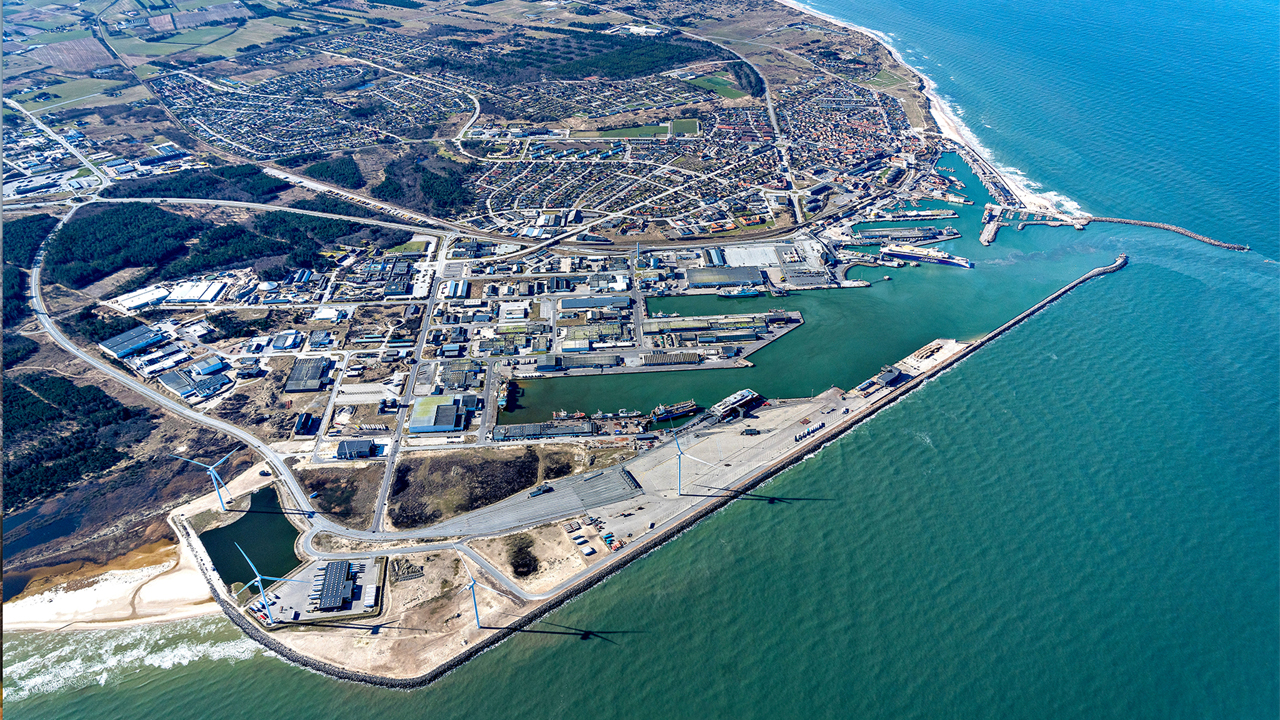
Port of Hirtshals, North Jutland · In development · operation targeted 2029
In North Jutland the regional 60 kV grid is effectively fully utilized, and the reinforcement of the 150 kV transmission network is expected to be 10–15 years away. That is holding back both new industry and renewable generation in the region.
SATURN Hirtshals answers this bottleneck. A private 18 km, 150 kV underground cable will connect the Green Power Station at the Port of Hirtshals to Energinet’s Bredkær station, releasing 150 MW of import and export capacity. The cable is prepared for expansion to about 250 MW and could, on commercial terms, become part of the public transmission grid over time. WeStorix acts as a single counterparty toward the system operator, while renewable producers and industrial consumers connect behind the same meter as an Energy Hub.
The hub pipeline includes around 110 MW of renewable generation and more than 100 MW of demand: data-center capacity, ferry and maritime charging, port shore power, Power-to-X and heavy-duty truck charging.
SATURN Hirtshals is the reference design for SATURN Vejle and the stations that follow.
Key facts
| Grid connection | 150 MW import/export at 150 kV |
|---|---|
| Route | 18 km private underground cable to Bredkær |
| Grid-forming PCS | 92 MW |
| Energy storage | 375 MWh, LFP-based, ≈ 4 hours |
| Build | 2027–2028 · operation targeted 2029 |
Text description of this illustration
An 18 kilometre private 150 kV underground cable connects Energinet’s Bredkær 150 kV station to the Green Power Station at the Port of Hirtshals, providing 150 MW of import and export capacity. Inside the station, a 150/33 kV substation feeds medium-voltage busbars at 33 kV and 10 kV. The BESS consists of a 92 MW grid-forming PCS and 375 MWh of LFP energy storage, with a control layer linked to the EMTC. Direct lines start at the busbars inside the station and connect the Energy Hub pipeline: about 110 MW of renewable generation, data-center demand of up to 80 MW, ferry and maritime charging of up to 80 MW peak, about 10 MW of port shore power, about 15 MW of Power-to-X and about 18 MW of heavy-duty truck charging. Participants shown are the development pipeline, not signed contracts.